Aspects
Aspect
An aspect is the angle between two planets, measured around the zodiac circle. Only certain angles count as major aspects, and each is read as a particular kind of relationship between what the two planets stand for: some flowing and easy, others charged with tension. Aspects tie single placements together into a pattern. Whether an aspect is felt depends on how close it is to exact, its orb.
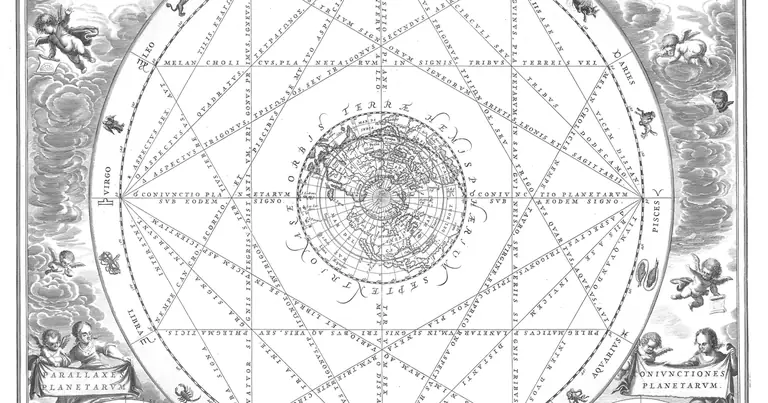
Astrologers measure an aspect in degrees of the zodiac circle, counting from one planet's position to the other's. Only certain angles are treated as meaningful, and those are the ones astrologers watch when they read how the parts of a chart talk to each other.
How dividing the circle gives the major aspects
Every planet has a position along the ecliptic, given in degrees from 0 to 360. Subtract one from the other and you have the angle between them. The major aspects are the angles you get by dividing the full circle by small whole numbers. Split 360 in two and you get the opposition at 180 degrees; in three, the trine at 120; in four, the square at 90; in six, the sextile at 60. Zero degrees apart is a conjunction. Divide by larger numbers and you reach the minor aspects, like the 45-degree semi-square (one eighth of the circle); the 150-degree quincunx is five twelfths.
Hard aspects, soft aspects and how tight the angle is
Tradition sorts the aspects into families. Squares and oppositions are the hard aspects, read as tension that demands action. Trines and sextiles are the soft aspects, read as ease and support. The conjunction merges two planets and takes its tone from them. A reading looks at which planets are in aspect and how tight the angle is, because a closer aspect is felt more plainly than a loose one. The planets involved matter as much as the angle, since the same square reads one way between the Moon and Venus and quite another between Mars and Saturn.
Sun at 10° Aries, Moon at 12° Cancer: a square
Suppose the Sun sits at 10 degrees of Aries and the Moon at 12 degrees of Cancer. The gap between them is 92 degrees, close enough to the 90 of a square to count. An astrologer would read that as inner friction between what you want and what you feel, the kind of pull that keeps a person restless until they work it out.
Angle versus sign, and major versus minor
An aspect is the angle, not the sign: two planets in the same sign are not automatically conjunct, and two planets in neighboring signs can be. Beginners often count aspects by sign alone, which is a rougher whole-sign method, when most modern readers measure the exact degrees and apply an orb. Major and minor aspects are weighed differently, and the minors are given tighter tolerances.
Aspects between two people's planets
The NovaOracles compatibility tool maps the aspects between two people's planets, and the transits guide shows how the sky's current aspects touch your chart.
FAQ
Frequently asked questions
What are the major aspects in astrology?
The conjunction at 0 degrees, the sextile at 60, the square at 90, the trine at 120 and the opposition at 180. These five come from dividing the circle by small whole numbers.
How are aspects measured?
By the angular distance between two planets along the zodiac, in degrees. The aspect counts when that distance lands near an exact angle, within a tolerance called the orb.
What is a hard aspect versus a soft aspect?
Squares and oppositions are called hard, read as tension and drive. Trines and sextiles are called soft, read as ease. The conjunction can go either way depending on the planets.
Sources
Try it
Open the free toolRelated terms
The Journal
How a transit touches your chartRead the guide
TransitsSee how this shows up in your own chart.
Find it in my chart