Aspects
Conjunction
A conjunction is two planets at the same degree of the zodiac, zero degrees apart. Sitting together, their meanings blend and reinforce each other, so the pairing acts almost as one combined force. It is the most intense of the aspects, and whether it feels supportive or demanding depends on the planets involved and the rest of the chart. A wide conjunction, still within orb, blends more loosely.
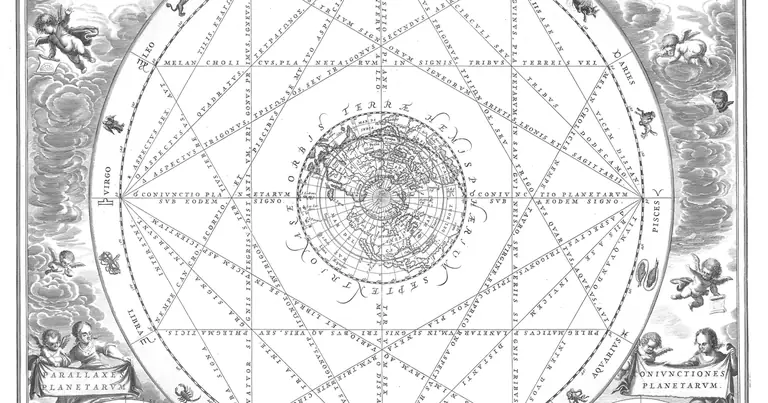
The conjunction is the aspect with no gap in it: the two planets share a degree of the zodiac, or sit within a few degrees of each other. Their separate meanings stop acting alone and start working as one, which can be powerful or simply a lot, depending on the pair.
When the faster planet catches the slower one
When two planets share the same spot along the ecliptic, they appear close together in the sky, sometimes near enough to see side by side at dusk. Because the faster planet has just caught up to the slower one, a conjunction marks the start of a fresh cycle between them. The clearest example runs overhead every month: the new moon is nothing more than the Sun and Moon in conjunction, the two lined up at the same degree.
Fusion, combustion and a single blended voice
Tradition treats a conjunction as a fusion. The two planets pool their nature, for better or for heavier. Venus with Jupiter is read as ease, warmth and good fortune; Mars with Saturn as effort held back, drive meeting a brake. Old texts even called a planet too close to the Sun combust, its light overwhelmed. A conjunction near an angle of the chart, like the ascendant, is read as especially loud. The two planets do not take turns; they act at the same time and through the same events, which is what makes a conjunction feel less like a conversation and more like a single blended voice.
Venus and Mars together at 5° Leo
Say Venus and Mars meet at 5 degrees of Leo in a chart. Venus is affection and taste, Mars is desire and push, and side by side they read as a strong romantic charge, someone who pursues what they want with warmth and heat at once. Move either planet a couple of signs away and the merge dissolves into a different, looser relationship.
Conjunction, stellium and the limit of the orb
A conjunction of three or more planets in one sign is usually called a stellium instead, since the weight changes with the crowd. People also assume a conjunction is automatically fortunate, when its tone depends entirely on the planets. And two planets more than a reasonable orb apart are not really conjunct, however close they look on the wheel.
The conjunctions marked in your chart
The NovaOracles birth chart tool marks the conjunctions in your chart, and the transits guide shows what happens when a moving planet forms one with your natal placements.
FAQ
Frequently asked questions
What does a conjunction mean in astrology?
Two planets sitting at nearly the same zodiac degree, so their meanings merge and amplify. The result takes its flavor from which two planets are involved.
Is a conjunction good or bad?
Neither on its own. A Venus and Jupiter conjunction reads as warm and lucky, while a Mars and Saturn conjunction reads as heavy or frustrated. The planets decide the tone.
What is the orb for a conjunction?
Astrologers usually allow a wide orb for a conjunction, often up to eight degrees, and more when the Sun or Moon is involved. The tighter the gap, the stronger the blend.
Sources
Try it
Open the free toolRelated terms
The Journal
How a transit touches your chartRead the guide
Compatibility and synastrySee how this shows up in your own chart.
Find it in my chart