No. 05 · Relationships
Compatibility and synastry, explained
NovaOracles, by OZGN Studio · September 16, 2026
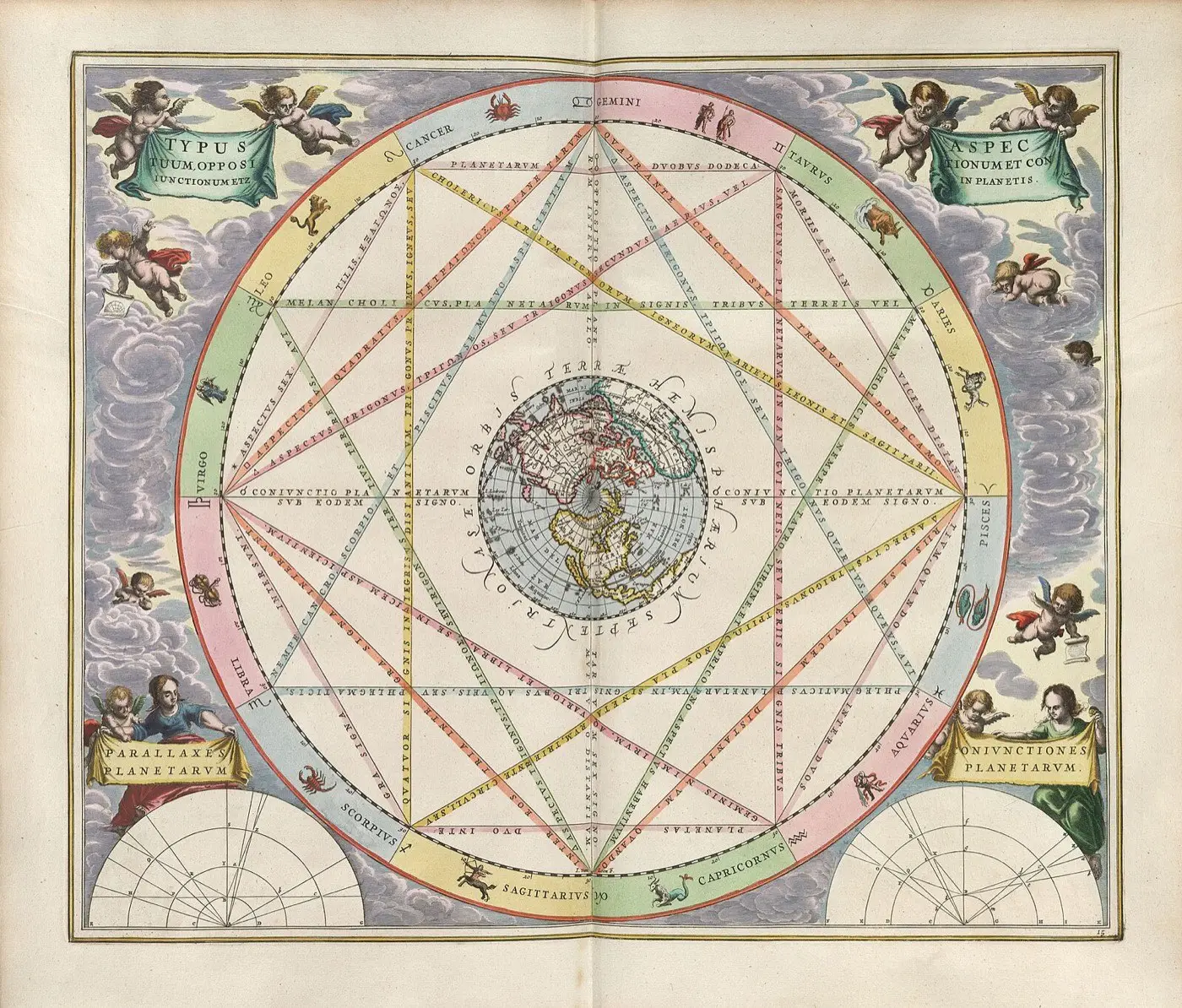
Compatibility in astrology is not a verdict on whether two people belong together. It is what happens when you lay one birth chart over another and read the real angles between them, and it has a name: synastry. Here is what those contacts are, what a harmony score can honestly tell you, and where the reading ends and the two people begin.
What synastry actually is
Synastry is the astrology of two charts at once. You take two complete natal charts, each computed for its own moment and place of birth, and lay them over each other to see how one person's planets fall against the other's. The unit of the reading is the inter-chart aspect: the angle from your Venus to their Moon, from their Saturn to your Sun, and so on around both wheels. Nothing new is invented, it is the same geometry astrology always uses, applied across two people.
Because it works from two real charts, synastry is only as good as the birth data behind it. Two dates give you the Sun and most of the planets for each person; two exact times add the Moons on their fast days and, crucially, the ascendants and houses. With the times in hand you can see not just which planets touch, but which rooms of each person's life the other tends to walk into.
It also matters that synastry is symmetric and specific at once. The same two charts produce different contacts depending on whose planet you start from: your Saturn on their Sun is not the same story as their Saturn on your Sun. Reading both directions is part of the work, and it is one more reason a compatibility summary is a starting point for conversation rather than a scoreboard.
The astronomy under a compatibility reading
It is easy to assume compatibility is a vibe, but the measurable part of it is plain astronomy. Each chart is a set of positions along the ecliptic, computed from the same planetary data observatories use. An inter-chart aspect is just the difference between two of those positions: zero degrees is a conjunction, sixty a sextile, ninety a square, one hundred twenty a trine, one hundred eighty an opposition. The angles are exact, and a small orb of a few degrees decides how tight, and how strongly felt, each one is.
This is the honest floor under any compatibility tool. Whatever meaning gets layered on top, the contacts themselves are real measurements, not guesses. NovaOracles computes both charts to the arcminute and then finds the aspects between them, so the pattern you are handed reflects where the planets actually were for each of you, not a template. The interpretation is the human part; the geometry is not.
The orb is where judgment enters. A contact that is exact to the degree is loud; one that is five or six degrees wide is a whisper, present but easily outweighed. Good synastry weighs the tight contacts and does not make too much of the loose ones, which is also how a fair compatibility score should behave, giving the exact aspects their due and letting the distant ones recede.
The contacts astrologers actually read
Not every angle carries the same weight, and tradition leans on a few. Sun to Moon between two charts is read as one of the warmest, a meeting of purpose and feeling. Venus to Mars is read as attraction, Moon to Moon as emotional ease or its absence, and Saturn contacts as the weight of commitment and, sometimes, of duty. Aspects to each other's ascendant matter too, because the ascendant is how each person first meets the world.
The angle sets the tone. Conjunctions merge two planets' themes, trines and sextiles let them flow, and squares and oppositions create the friction that can read as either chemistry or strain depending on the couple. This is why the same contact can feel electric for one pair and tiring for another: the geometry is fixed, but two whole charts, and two whole people, sit underneath it.
It is worth naming what synastry does not measure. It says nothing about values you have talked through, the history you share, or the plain daily effort a relationship runs on. Two charts can describe a strong pull and leave out everything two people decide to build on top of it. The contacts are real, and they are only ever part of the story.
What a harmony score can and cannot say
A compatibility score is a summary, nothing more. It counts the inter-chart aspects, weighs the harmonious ones against the frictional ones, factors in how tight each is, and returns a single number so you can see the overall shape at a glance. That is genuinely useful for orientation. What it is not is a measurement of love, or a forecast of whether a relationship will last, and no honest tool will dress it up as one.
It also helps to retire the idea that squares are bad and trines are good. Friction is often what gives a relationship its energy and its reasons to grow, while ease left unchallenged can drift. A high score is not a guarantee and a low one is not a warning. A synastry reading is a mirror held up to two charts, a way to see patterns and talk about them, and the relationship itself stays the work of the two people in it.
A last honest note on scores: they compress. Two couples can reach the same number by very different routes, one calm and one lively, and the figure alone will not tell them apart. That is why the useful output is not only the number but the contacts behind it, laid out plainly, so you can see what the score is actually made of.
Synastry and the composite chart
Synastry is one of two common ways to read a pair, and it helps to know the other. A composite chart takes the midpoints between the two people's planets, the halfway point between your Sun and theirs, and so on, and draws them as a single new chart. Where synastry shows two people interacting, the composite is read as the relationship itself, treated almost as its own third entity with its own chart.
The two views answer different questions. Synastry asks how you affect each other, contact by contact. The composite asks what the relationship is like as a thing in its own right. Neither replaces the other, and neither is a verdict. Together they are simply two angles on the same pair, both built, in the end, from the same real positions in the sky.
Birth times, and how much they matter
A fair question before you start: do both people need an exact birth time? For a first pass, no. Two birth dates give you the Sun, Mercury, Venus, Mars and the outer planets for each person, which is enough to see most of the major inter-chart aspects. What you lose without times are the two Moons on the days they change sign, both ascendants, and the houses, which is where a contact lands in each life.
So a timed synastry is richer, but a dateless comparison is not worthless; it is honest about what it can and cannot show. If one time is known and the other is not, the reading can still use everything the known data allows and simply leave the uncertain points open. As always, it is better to leave a point blank than to guess it and build a reading on a horizon that was never there.
How the free Compatibility tool computes it
NovaOracles' Compatibility tool does the whole calculation from real astronomy and hands you the reading on the page. You enter two sets of birth details; it computes both natal charts to the arcminute, finds the aspects between them, weighs the harmonious against the frictional, and returns both a summary and the specific contacts behind it. There is no account and nothing is sent anywhere.
What you get back is a mirror, not a verdict. It will show you where two charts flow and where they rub, in plain language, with the astronomy kept honest underneath. It will not tell you what to do, because that was never astrology's to decide. Read it as a way to understand each other a little better, and let the choices stay yours.
You can also use it lightly. Run it for a partner, a friend or a family member, and read it as a prompt for understanding rather than a scorecard to pass or fail. The interesting parts are usually the specific contacts, a warm Moon link, a demanding Saturn one, because those are where a vague sense of a relationship turns into something you can actually name and talk about.
Sources
Terms in this piece
Read the guide
Compatibility and synastryRead your own sky, not a generic one.
NovaOracles computes your full natal chart from real astronomy: your rising sign, your big three, every house and every aspect, personal to the minute you were born.
Get your full chartRead next
The zodiac, explained