No. 06 · Foundations
The zodiac, explained
NovaOracles, by OZGN Studio · September 16, 2026
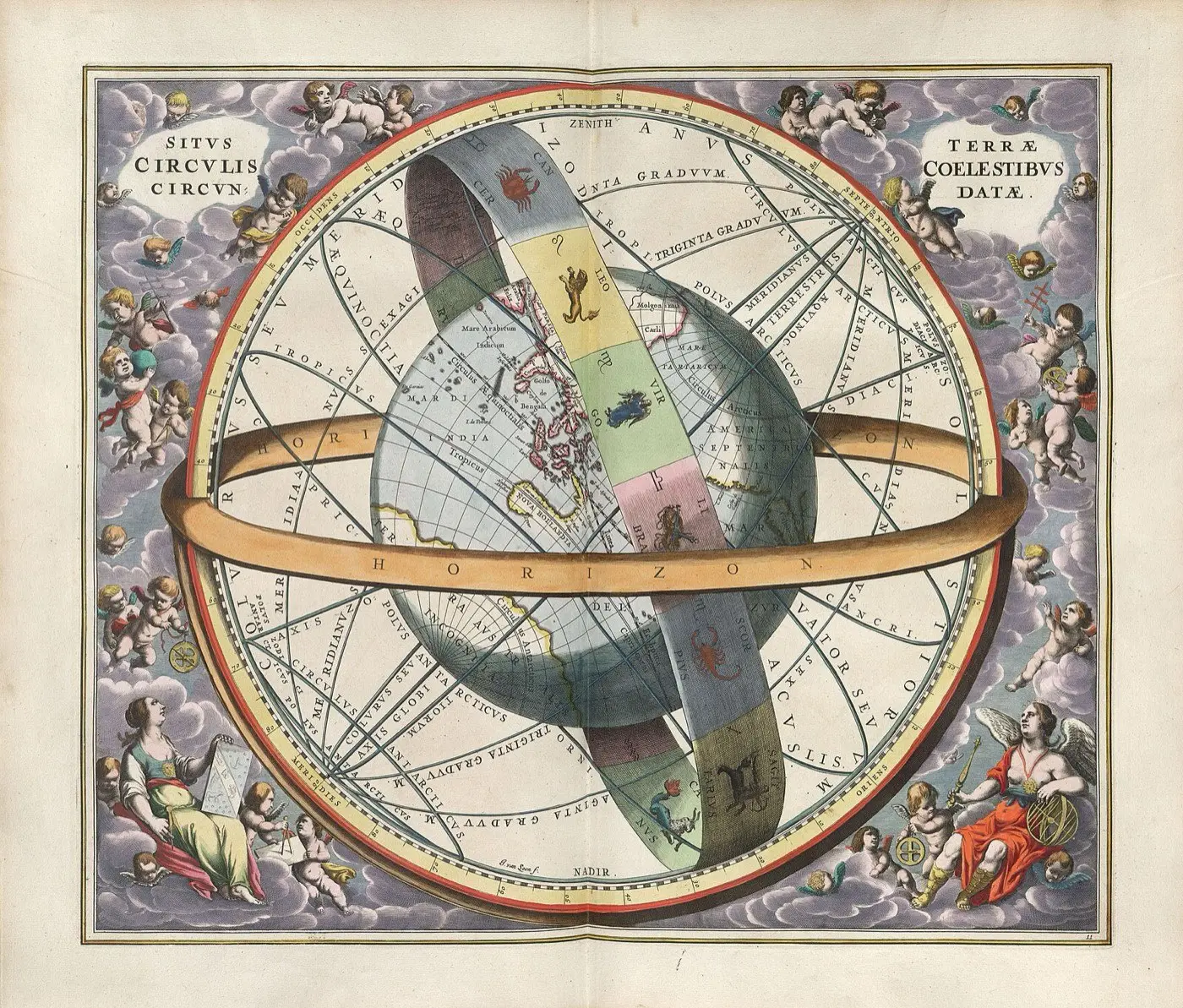
The zodiac is one of the oldest ideas in astronomy, and one of the most misunderstood. Strip away the mythology and it is a piece of geometry: a band of sky, centered on the Sun's yearly path, divided into twelve equal parts. Here is what that band is, why the signs drift from the constellations that share their names, and how NovaOracles handles the parts people argue about.
The zodiac is a band of sky
Start with the Sun. Over a year it appears to trace one great circle around the sky, always returning to the same path, and that path is called the ecliptic. The Moon and planets never wander far from it, staying within a band roughly eight or nine degrees on either side. That band is the zodiac. Everything astrology tracks, every planet and every sign, happens inside this narrow ring around the sky.
To make it usable, the ancients divided the band into twelve equal parts of thirty degrees each, twelve times thirty being the three hundred sixty degrees of a full circle. Each part is a sign. The signs are not lumps of stars, they are equal slices of a circle, a coordinate system laid over the sky. That is the first thing to get straight, because almost every argument about the zodiac comes from confusing the slices with the star pictures behind them.
The word itself records how old the idea is. Zodiac comes from a Greek phrase meaning circle of little animals, after the creatures in so many of the signs, and versions of the same twelve-fold band appear in Babylonian records more than two thousand years ago. What began as a way to track the Sun, Moon and planets against the fixed stars became, over centuries, the shared alphabet of astrology.
Signs are not the same as constellations
The twelve signs borrowed their names from twelve constellations the Sun passes in front of, but the two have quietly come apart. Constellations are real groupings of stars, and they are wildly uneven: the Sun spends a few weeks crossing some and only days crossing others. There is even a thirteenth, Ophiuchus, that the ecliptic clips, which is why headlines about a secret extra sign resurface every few years.
The signs, by contrast, are always twelve, always thirty degrees, always equal. When astrology says the Sun is in Aries, it means the Sun is in the first thirty-degree slice measured from a fixed starting point, not that it sits inside the star pattern called Aries. Once you hold that difference, the supposed scandal of the thirteenth sign dissolves: it is a fact about constellations, and the signs were never constellations to begin with.
The confusion is old and understandable. The signs and constellations shared names for a reason: two thousand years ago they nearly overlapped. Time, and the slow wobble described in the next section, pulled them apart. So the names are a kind of historical fingerprint, a record of where the sky sat when the system was written down, not a claim about where the stars are tonight.
Tropical and sidereal: two ways to anchor the circle
If the signs are slices, everything depends on where slice one begins, and there are two honest answers. The tropical zodiac starts the circle at the March equinox, the point where the Sun crosses the celestial equator and spring begins in the north; zero degrees of Aries is that moment, so the tropical signs track the seasons. The sidereal zodiac instead anchors the circle to the fixed stars, keeping the signs lined up with the constellations they were named for.
Neither is a mistake, they answer different questions. Tropical astrology, used across most of the Western world, is a calendar of the Sun's relationship to the Earth's seasons. Sidereal astrology, used in much of India, is a map of the Sun against the background stars. NovaOracles uses the tropical zodiac, the standard for Western charts, and says so plainly, because which zodiac a chart uses is exactly the kind of thing that should never be hidden.
The gap between the two systems is not small, and it is not hidden. A chart cast in the tropical zodiac and the same chart cast sidereally will place many planets a full sign apart. That is why naming the system matters: a sign only means something once you know which zero point it was measured from. Saying tropical up front is part of keeping the astronomy honest.
Precession, and why the two drift apart
The two zodiacs once lined up, and they no longer do, because of a slow wobble called precession. The Earth's axis turns in a great circle like a spinning top winding down, completing one turn in roughly twenty six thousand years. That drags the equinox point slowly backward against the stars, about one degree every seventy two years. Over two thousand years the gap has grown to about twenty four degrees.
So the tropical sign and the background constellation have separated by nearly a whole sign. This is the real content behind the claim that your sign has changed: measured against the stars, the Sun on your birthday may sit in the constellation before the one your tropical sign names. Tropical astrology never claimed otherwise, it tracks the season, not the star field. The drift is real astronomy, and it changes nothing about how a tropical chart is read.
Elements and modalities: the grid behind the signs
The twelve signs are not a random list, they are organized by two simple schemes that repeat around the circle. The four elements, fire, earth, air and water, describe temperament, and each is shared by three signs. The three modalities, cardinal, fixed and mutable, describe a way of moving through things: cardinal starts, fixed sustains, mutable adapts, and each is shared by four signs.
Cross the four elements with the three modalities and you get twelve unique combinations, one for every sign. Aries is cardinal fire, Taurus fixed earth, and so on with no repeats. This grid is why signs in the same element feel like family and signs in the same modality share a tempo. It is also a compact way to read a chart at a glance, by seeing which elements and modalities a person's planets pile up in.
The pattern is easy to see once you know it. Go around the circle and the elements cycle fire, earth, air, water, over and over, while the modalities cycle cardinal, fixed, mutable. Because twelve divides evenly by both four and three, every sign lands on a unique pair, and the whole zodiac turns out to be a tidy multiplication table rather than a list to memorize.
Cusps, and where the Sun really is
Because the tropical year is about three hundred sixty five and a quarter days, the calendar and the sky drift by a few hours each year and snap back at each leap year. That is why sign dates are never fixed to the day: the Sun can cross from one sign into the next on the twenty second one year and the twenty third the next. If you were born on one of those boundary days, you were born on a cusp.
There is a tidy myth that a cusp birth makes you two signs at once. Astronomically it does not: at any instant the Sun is at one exact degree of the ecliptic, in one sign, and that is that. The only way to know which is to compute the Sun's real position for your date, time and year, rather than trust a printed table. On a cusp, the table guesses and the computation answers.
This also means there is no need to feel caught between two identities. A cusp is not a blend of two signs, it is simply a birthday close enough to a boundary that only the real numbers can place it. Once computed, your Sun sits cleanly in one sign, and the chart proceeds from there like any other.
How the free Zodiac Sign Dates tool works
This is exactly what NovaOracles' Zodiac Sign Dates tool is for. Instead of reading a fixed table of date ranges, it computes the Sun's real position along the ecliptic for the date you enter, using the same real astronomy as the rest of the site. For most birthdays the answer matches the familiar ranges; on a cusp, it settles the question honestly instead of guessing.
It answers right on the page, with no account and nothing sent anywhere. And it is only a doorway: your Sun sign is the headline of a chart, not the whole story, and the Moon and rising sign fill in the rest. The zodiac is a coordinate system, beautifully old and genuinely useful, and understanding it is the first step to reading the sky as a mirror rather than a verdict.
Sources
Terms in this piece
Read the guide
The zodiacRead your own sky, not a generic one.
NovaOracles computes your full natal chart from real astronomy: your rising sign, your big three, every house and every aspect, personal to the minute you were born.
Get your full chartRead next
Your rising sign, explained