The zodiac
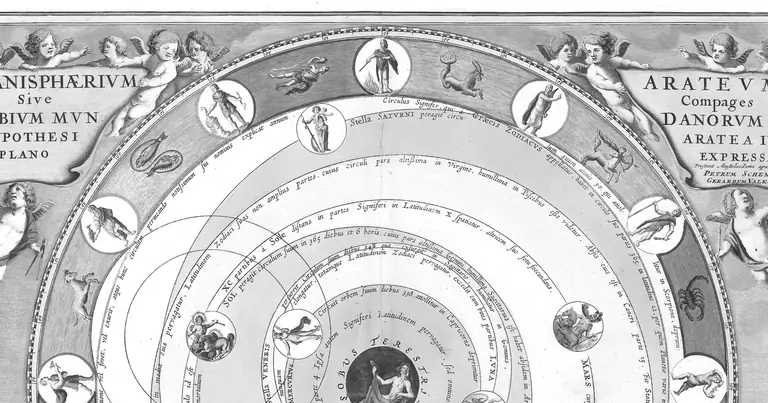
Strip away the mythology and the zodiac is a piece of geometry: a band of sky centered on the Sun's yearly path, divided into twelve equal signs of thirty degrees each. This guide explains what the zodiac is, how the signs are sorted into elements and modes, how the planets move through them, and the real astronomy the whole system is built on.
01
What is the zodiac?
01
What is the zodiac?
The zodiac is the band of twelve signs, Aries through Pisces, that the Sun, Moon and planets appear to travel along through the year. Its center line is the ecliptic, the Sun's apparent yearly path around the sky, and each sign takes up an equal thirty-degree slice of the circle. The signs share their names with constellations but are not the same thing: the astrology here uses the tropical zodiac, tied to the seasons and the equinox, so a sign is a stretch of the Sun's path rather than a picture of stars. Your Sun sign is the slice the Sun was crossing when you were born. This is why your birthday, not the stars overhead tonight, decides your Sun sign.
The animal of a Chinese zodiac year changes at Lunar New Year, not on January 1; our Chinese zodiac years guide shows the dates.
02
Elements and modalities
02
Elements and modalities
The twelve signs are sorted two ways, and together these are the quickest read of a chart's style. The four elements, fire, earth, air and water, group the signs by temperament, three signs to each, and which element dominates a chart tells you its overall flavor. The three modalities, cardinal, fixed and mutable, group them by how they act: cardinal starts, fixed sustains, mutable adapts, four signs to each. Every sign is one element and one modality, a pairing unique to it, which is why no two of the twelve behave quite alike.
03
What are the decans in astrology?
03
What are the decans in astrology?
The decans divide each sign into three slices of ten degrees, so the zodiac holds thirty-six of them. The Sun moves about one degree a day, so each decan covers roughly ten days of a sign's season, and the exact days shift a little from year to year. Tradition reads the first decan as the purest form of the sign and lets the second and third borrow color from the other two signs of the same element.
In the scheme most astrologers use today, the three decans follow the element in zodiac order, starting from the sign itself. Aries runs through Aries, Leo and Sagittarius; Leo through Leo, Sagittarius and Aries; Sagittarius through Sagittarius, Aries and Leo. Earth signs cycle through Taurus, Virgo and Capricorn in the same way, air signs through Gemini, Libra and Aquarius, and water signs through Cancer, Scorpio and Pisces, always beginning with their own sign. Older texts give the decans to the planets in a different order, so this is one school's reading.
04
How the planets move through the zodiac
04
How the planets move through the zodiac
The signs are a track, and the planets are always moving along it. When a planet crosses from one sign into the next, that crossing is called an ingress: a change of flavor for that planet. The Sun's ingresses are the ones everyone feels, since they mark the seasons, the Sun entering Aries at the spring equinox and the other signs following around the year. Every other body has its own pace, from the Moon's swift monthly circuit of all twelve signs to the decades the outer planets take to round the zodiac once.
05
The real astronomy behind the zodiac
05
The real astronomy behind the zodiac
None of this is guesswork. The positions come from an ephemeris, a table of where each body sits over time, and NovaOracles computes its own from real astronomy, accurate to the arcminute. The zodiac sign dates tool marks where the Sun changes sign each year; the birth chart calculator places every planet in its sign for your own moment; and the Chinese zodiac tool covers a separate, year-based system if you want to compare. Wherever a sign appears on the site, it is drawn from that same computed sky.
Terms in this hub
Free tools
- FreeZodiac sign dates Enter your birthday and get your true Sun sign, computed from the Sun's actual position on your birth date.
- FreeSidereal chart calculator Your Vedic birth chart in the sidereal zodiac with the Lahiri ayanamsa, next to the tropical wheel for the same moment.
- FreeBirth chart calculator Your complete natal chart, computed from real astronomy: Sun, Moon and rising sign, all ten planets, houses and aspects, drawn on an interactive wheel.
- FreeChinese zodiac calculator Find your Chinese zodiac animal, element and polarity, with the Lunar New Year boundary handled correctly.
From the Journal
From the Journal
- Aries Zodiac Sign: Traits, Personality and Symbol
- Taurus Zodiac Sign: Traits, Personality and Symbol
- Gemini Zodiac Sign: Traits, Personality and Symbol
- Cancer Zodiac Sign: Traits, Personality and Symbol
- Leo Zodiac Sign: Traits, Personality and Symbol
- Virgo Zodiac Sign: Traits, Personality and Symbol
- Libra Zodiac Sign: Traits, Personality and Symbol
- Scorpio Zodiac Sign: Traits, Personality and Symbol
- Sagittarius Zodiac Sign: Traits, Personality and Symbol
- Capricorn Zodiac Sign: Traits, Personality and Symbol
- Aquarius Zodiac Sign: Traits, Personality and Symbol
- Pisces Zodiac Sign: Traits, Personality and Symbol
Guides
Guides to your chart.