Points and angles
Lunar nodes
The lunar nodes are the two points where the Moon's orbit crosses the ecliptic, the Sun's path. The North Node is where the Moon crosses going north, the South Node where it crosses going south, and the pair always sits exactly opposite. They are not bodies but calculated points, drifting slowly backward through the zodiac over about eighteen and a half years. Astrologers see the nodal axis as a line of growth and release, and eclipses happen when a new or full moon lands near a node.
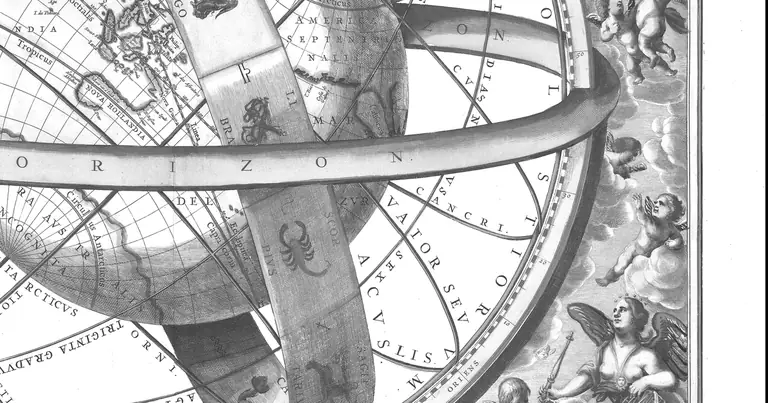
The lunar nodes are two invisible points, not objects you could photograph, yet they carry more weight in a reading than many planets. They mark where the Moon's tilted orbit cuts across the Sun's path, and they are the hinge that eclipses swing on.
Where the Moon's tilted orbit crosses the ecliptic
The Moon does not orbit in the same plane as the Earth and Sun; its path leans about five degrees off the ecliptic. Any two crossing circles meet at two points, and here those are the lunar nodes. Where the Moon climbs north through the ecliptic is the ascending, or north, node; where it drops south is the descending, or south, node. The two always sit exactly opposite each other. They do not hold still: the nodes slide slowly backward through the zodiac, completing a full circuit in about 18.6 years, spending roughly a year and a half in each sign. When a new or full moon lands near a node, you get an eclipse.
North node for growth, south node for habit
Tradition reads the nodal axis as a line of growth. The north node points to what you are meant to develop, the unfamiliar direction that stretches you; the south node marks the well-worn, the gifts and habits you already lean on and may need to loosen. Older texts call the north node the dragon's head and the south node the dragon's tail. Eclipses are said to activate this axis, which is part of why they feel so tied to fate.
North node in Gemini, south node in Sagittarius
Say a chart has the north node in Gemini and the south node in Sagittarius. A reader might describe someone who grows by staying curious, asking questions and listening to what is near at hand, while easing off the urge to have the whole answer already. Because the nodes move backward, that Gemini and Sagittarius placement lasts about a year and a half before the axis slips back into Taurus and Scorpio.
Points, not planets: the mean node and the true node
The nodes are points, not planets, so nothing physical sits there. The north and south node are always a matched pair, 180 degrees apart, never wandering off on their own. And there are two versions in common use, the mean node and the true node, computed slightly differently, so two charts can show the nodes a degree or so apart.
Your nodal axis and the 2026 eclipses
The NovaOracles birth chart tool plots your nodal axis, the moon and eclipses guide ties the nodes to eclipses, and why eclipses matter follows the axis through 2026.
FAQ
Frequently asked questions
What are the lunar nodes in astrology?
The two points where the Moon's tilted orbit crosses the ecliptic. They are not bodies but crossing points, and they always sit exactly opposite each other in the chart.
What is the difference between the north and south node?
The north node is read as the direction of growth, what you are learning to develop. The south node is the familiar, the habits and gifts you already lean on and may need to loosen.
How often do the lunar nodes change signs?
About every year and a half. The nodes drift backward through the zodiac and complete a full circuit in roughly 18.6 years.
Sources
Try it
Open the free toolRelated terms
The Journal
Why eclipses matter in a birth chartRead the guide
Moon phases and eclipsesSee how this shows up in your own chart.
Find it in my chart