No. 04 · The sky
Why eclipses matter more than you think
NovaOracles · August 27, 2026
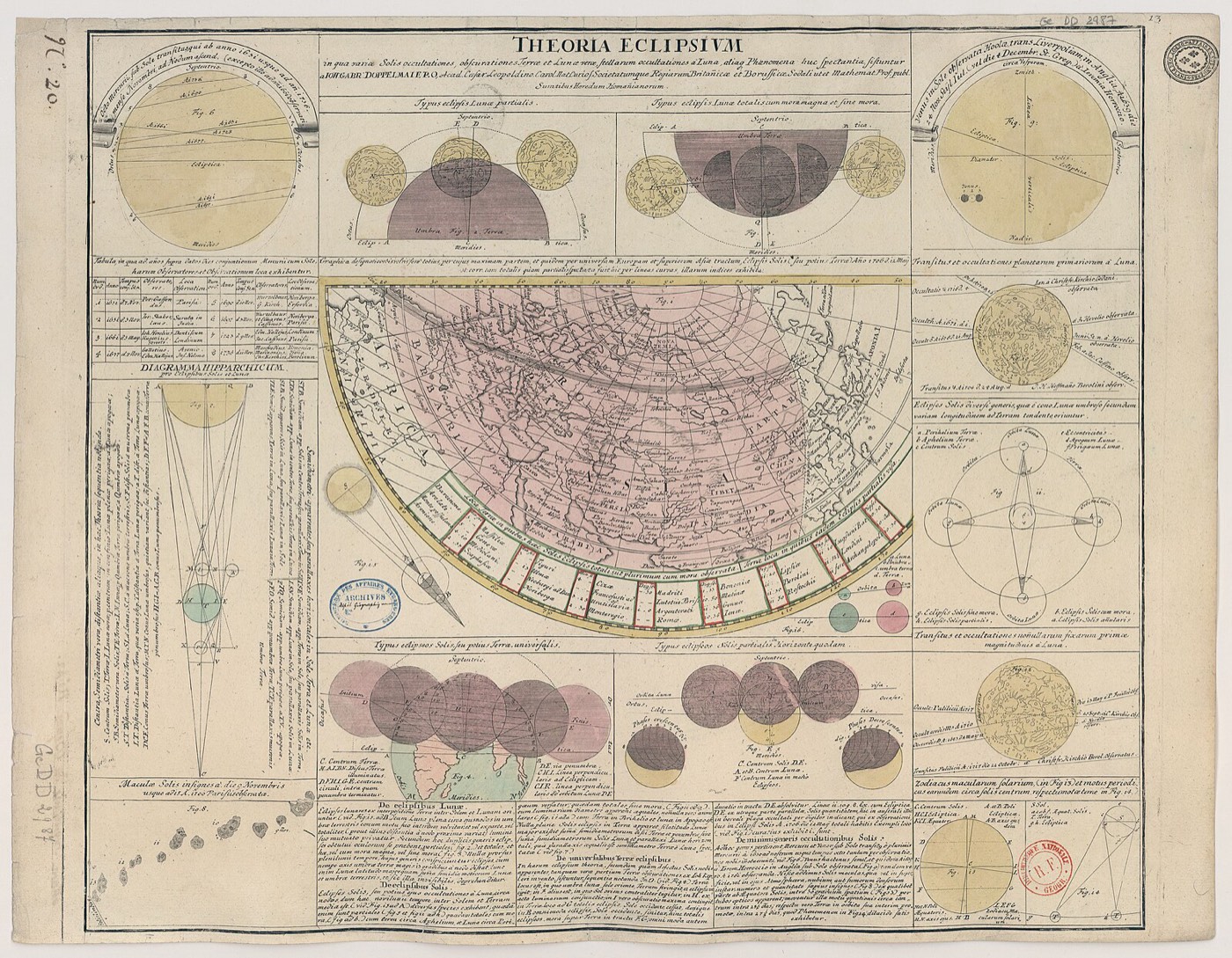
Eclipses are the sky's punctuation marks. They arrive in pairs along the lunar nodes, they retell one story across about eighteen months, and when one lands on a sensitive point of your chart it tends to close a door and open another. A short guide to reading them without fear.
Two shadows, one alignment
An eclipse is ordinary celestial mechanics performed with unusual precision. A solar eclipse is a new moon in which the Moon stands exactly between Earth and Sun, casting its shadow on us. A lunar eclipse is a full moon in which Earth stands exactly between Sun and Moon, and our shadow crosses the lunar face. The key word is exactly: new and full moons happen every month, eclipses only when the alignment is true in three dimensions.
That truth depends on the lunar nodes, the two points where the Moon's tilted orbit crosses the Sun's apparent path. Only when a new or full moon falls close to a node do the three bodies line up well enough for a shadow. This is why eclipses come in seasons, roughly twice a year, a solar and a lunar eclipse two weeks apart.
Why astrologers read them as turning points
In astrology the Sun and Moon are the two lights, the symbols of purpose and instinct. At an eclipse one of the lights is briefly interrupted on schedule, and the tradition has always read that as punctuation: something ends mid sentence, something else begins. Solar eclipses, being supercharged new moons, tend to mark beginnings that arrive faster than planned. Lunar eclipses, supercharged full moons, tend to bring culminations, disclosures and endings.
The practical experience is less cinematic than the reputation. Eclipse seasons feel like weeks in which events are slightly larger than your decisions, doors close without consultation and shortcuts appear in walls. The old advice holds: do not force outcomes during an eclipse, watch what leaves and what arrives.
The nodes tell one long story
Because eclipses cluster at the nodes, and the nodes drift slowly backward through the zodiac, eclipses arrive in themed series. For about eighteen months they fall along one axis of signs, hitting the same two houses of your chart again and again before moving on for roughly nine years. Each eclipse in the series is a chapter of the same story rather than an isolated event.
This is the most useful thing to know about eclipse astrology: the meaning is cumulative. What a given eclipse stirs in April is usually the continuation of what its siblings stirred the previous autumn. Kept in a journal, or read against a computed chart, the pattern becomes hard to miss.
How an eclipse touches your own chart
An eclipse matters to you in proportion to what it touches. Find the degree of the eclipse and look at your natal chart: the house where that degree falls names the arena of life under renovation, and any natal planet within a few degrees of it is directly in the story. An eclipse on your ascendant or on a natal light tends to mark a genuinely memorable season; one landing in a quiet corner of the chart may pass with barely a ripple.
None of this requires fear, only a chart that is actually computed. NovaOracles places every eclipse against your natal houses and planets, so instead of a headline about the sky in general, you get the only question that matters: where does this one land for me?
Read your own sky, not a generic one.
NovaOracles computes your full natal chart from real astronomy: your rising sign, your big three, every house and every aspect, personal to the minute you were born.
Get your full chart