The lunar cycle and eclipses
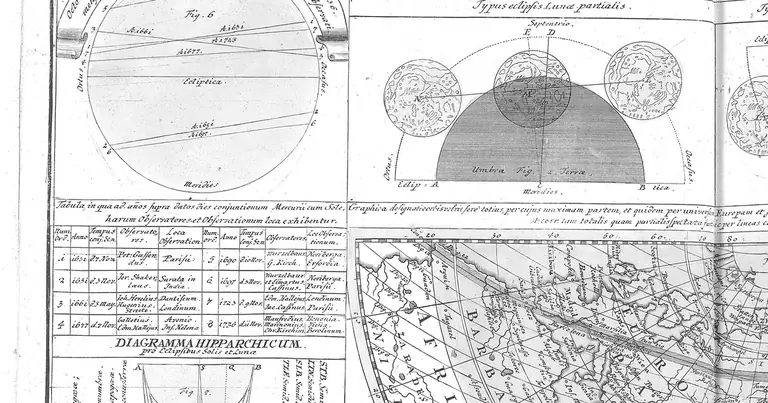
The Moon is the fastest body in the sky, and its rhythm is the easiest to feel: it waxes and wanes over about twenty-nine and a half days, and twice a year, near the lunar nodes, that rhythm sharpens into eclipses. This guide covers the phases, the new and full moons, the nodes and the eclipses, with the terms, free tools and Journal articles that explain them.
01
What are the Moon's phases?
01
What are the Moon's phases?
A moon phase is how much of the Moon is lit as it orbits Earth, from new to full and back over about twenty-nine and a half days. At the new moon the Moon sits between Earth and Sun and shows no lit face, a dark, quiet reset traditionally kept for beginnings. About two weeks later the full moon stands opposite the Sun and is fully lit, when things tend to come to a head and into the open. The waxing and waning stretches between are read as building and releasing, and the sign the Moon is passing through tints each phase.
02
The void-of-course Moon
02
The void-of-course Moon
As it circles, the Moon makes a series of angles to the planets, then leaves a sign behind. The gap after its last major aspect in a sign, until it slips into the next, is called void of course. It is an old idea that plans set in that window tend to drift or fizzle, so tradition treats it as time to rest, tidy and wait rather than launch. It is one of the gentler pieces of astrology, a suggestion to pick your moment. Its timing shifts every day, so a live calendar is the simplest way to catch it.
03
Why eclipses fall on the nodes
03
Why eclipses fall on the nodes
The Moon's orbit is tilted, so most months it passes above or below the Sun. The two points where its path crosses the ecliptic are the lunar nodes, and only when a new or full moon lands near a node do the Sun, Moon and Earth line up into an eclipse. A solar eclipse is a new moon on a node; a lunar eclipse is a full moon on a node. Because the nodes sit opposite each other, eclipses arrive in pairs about six months apart, and they retell one story across roughly eighteen months as the nodes slowly move around the zodiac. The same nodal axis can sit across your own chart, which is why some eclipse seasons land harder for you than others.
04
Reading the Moon and eclipses
04
Reading the Moon and eclipses
The lunar calendar tracks every day's phase, the new and full moons, and the sign the Moon is moving through, all computed from real astronomy. For the deeper reading on eclipses, follow through to the Journal, and the birth chart calculator shows where the nodes fall in your own chart. Eclipses are read as louder, fated-feeling lunations, but the frame stays the same here: a timer to notice, never a fate to dread.
Terms in this hub
Free tools
- FreeLunar calendar The month's moon phases, new and full moons, and the sign the Moon is in.
- FreeVoid-of-course Moon calendar Is the Moon void of course right now? The live answer, then every void period of the month in your time zone, with the last aspect and the sign ahead, for 2026 and 2027.
- FreeEclipse 2027 calculator The total solar eclipse of August 2, 2027, city by city: local times, how long totality lasts and how much of the Sun is covered.
- FreeNorth Node calculator Your North and South Node by sign and house, from the true node with the mean node beside it, and the months the node held that sign.
- FreeBirth chart calculator Your complete natal chart, computed from real astronomy: Sun, Moon and rising sign, all ten planets, houses and aspects, drawn on an interactive wheel.
- FreeEphemeris Every planet's position for each day of any month from 1900 to 2099, with the Moon's phases, ingresses, stations and a CSV download.
From the Journal
Read the guide
The phases of the MoonGuides
Guides to your chart.