The moving sky
Ecliptic
The ecliptic is the apparent yearly path the Sun traces across the sky, and it is the center line of the zodiac band. It is the plane of Earth's orbit projected onto the sky, which is why the Sun, Moon and planets all stay close to it, drifting only a little above or below. Astrology measures positions along this line, in ecliptic longitude, rather than by the constellations directly.
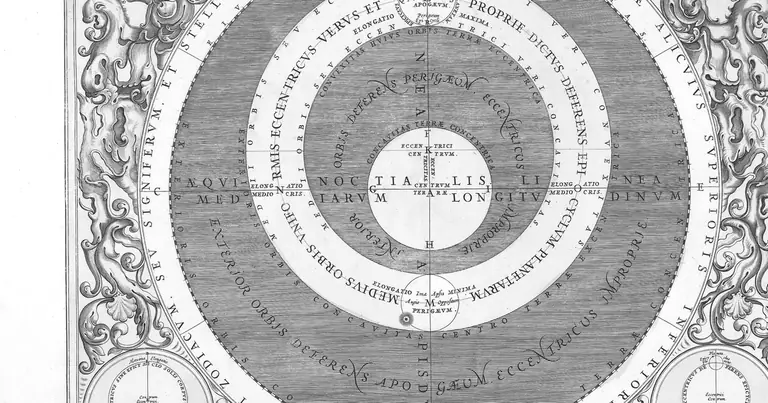
Mark the Sun's place against the background stars every day for a year and the marks join into one great circle, the ecliptic. It is also the spine of the whole zodiac, the circle everything in a chart is measured against. The Moon and planets never wander far from it, which is what makes it such a useful reference.
Earth's orbital plane projected onto the sky
The ecliptic is the plane of Earth's orbit, projected outward onto the sky. Since we ride along that plane, the Sun seems to move around it once a year. The planets orbit near the same plane, so they stay close to the ecliptic too, straying only a few degrees north or south. That is why the zodiac is a band reaching about eight or nine degrees to either side of the ecliptic rather than a single thread. The ecliptic is tilted roughly 23.4 degrees to the celestial equator, the projection of Earth's own tilt, and the two circles cross at the two equinox points, the March one marking the start of tropical Aries.
Ecliptic longitude as the chart's yardstick
Astrology places everything along this circle. A planet's sign and degree are its ecliptic longitude, measured from zero degrees of Aries all the way around to 360. Even a body that sits well off the plane is projected back onto the ecliptic to be given a zodiac position, so the line acts as the common yardstick for the entire chart. This is also why two planets at the same zodiac degree count as together even when one rides a little north and the other a little south of the plane, since their ecliptic longitude is what the reading uses.
The Moon's tilt and why eclipses sit on the ecliptic
The Moon's orbit is tilted about five degrees to the ecliptic, so most months it passes above or below the Sun rather than across it. Only when a new moon or full moon happens near a point where the Moon's path crosses the ecliptic do the three bodies truly line up and an eclipse follows. The name says it plainly: eclipses live on the ecliptic.
Ecliptic, celestial equator and zodiac
The ecliptic is not the celestial equator; the two are separate circles tilted about 23.4 degrees apart. It is also not the zodiac itself, but the center line the zodiac band surrounds. And the Sun does not really travel the ecliptic; Earth's own orbit makes it look that way.
Every planet plotted along the line
The NovaOracles birth chart tool plots every planet by its place on the ecliptic, and the zodiac fundamentals guide with the zodiac explained build out from this one line.
FAQ
Frequently asked questions
What is the ecliptic in astrology?
The apparent yearly path of the Sun across the sky, and the center line of the zodiac band. Astrologers measure every planet's position as a longitude along this circle.
Why is it called the ecliptic?
Because eclipses happen on or near it. An eclipse needs the Sun and Moon lined up, which can only occur where the Moon's tilted orbit crosses the ecliptic.
What is the difference between the ecliptic and the zodiac?
The ecliptic is a single line, the Sun's path. The zodiac is the band reaching about eight or nine degrees to either side of it, where the Moon and planets travel.
Sources
The Journal
How a transit touches your chartRead the guide
The zodiacSee how this shows up in your own chart.
Find it in my chart