The moving sky
Station
A station is the moment a planet appears to stop before it turns retrograde or direct. Its apparent motion slows to almost nothing at the turning point, holds for about a day, and then reverses. Astrologers treat a station as a time when that planet's themes feel especially loud, since its energy seems to gather and pause in one spot. A retrograde period begins at one station and ends at the next.
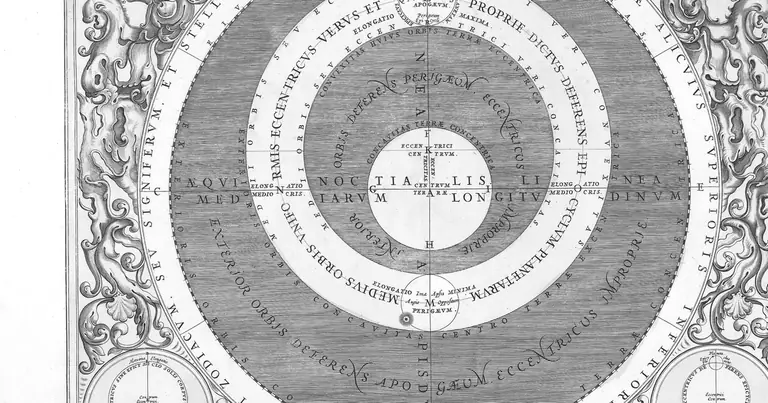
Every retrograde begins and ends with a station, a pause in the planet's apparent motion. For a few days on either side the planet seems almost fixed to one degree, and tradition reads that stillness as the planet at its loudest.
Apparent speed falls to zero
As a planet swaps between forward and backward motion, its apparent speed along the zodiac falls to zero at the exact instant of reversal. That instant is the station. Two of them frame every retrograde. The station retrograde comes first, where forward motion stops and the backward stretch begins; the station direct comes at the end, where the planet halts again and resumes its normal course. The planet is not motionless in space, only in its drift against the signs. Because it is barely moving, it dwells on the same degree for days, which is why a station lands with weight.
The stillest point of a retrograde
Tradition treats a station as the most charged part of a retrograde cycle. The planet sits on a degree and leans on it, so anything in your chart near that degree gets a long, insistent push. Readers watch the days around a station closely and often time the strongest effects of a retrograde to those pauses rather than to the middle of the backward run.
Mercury stationing direct near 8° Pisces
In 2026 Mercury stationed direct on 20 March near 8 degrees of Pisces. Anyone with a planet or angle close to 8 degrees of Pisces would have felt that Mercury theme drawn out for several days, since the planet hovered there instead of gliding past. The station, not the date it finally clears, is where the story peaks. Astrologers reading a chart will often note the exact degree of each station and check whether it lands on a natal planet, since a station sitting on a birth placement is read as a pointed and drawn-out emphasis on that part of life.
A station is a moment, a retrograde a stretch
A station is a single moment, while a retrograde is the whole backward stretch between two stations. "Stationary" does not mean the planet has stopped orbiting; only its motion through the zodiac reaches zero. And a station direct, which lifts a retrograde, is read quite differently from a station retrograde that begins one.
Station dates on the Mercury tracker
The NovaOracles Mercury retrograde tracker marks each station date, retrograde planets in 2026 lists the year's turns, and the transits guide sets stations in the wider picture.
FAQ
Frequently asked questions
What is a station in astrology?
The moment a planet's apparent motion through the zodiac slows to a stop and reverses. Every retrograde has two: a station retrograde at the start and a station direct at the end.
What is the difference between station retrograde and station direct?
A station retrograde is where a planet halts and begins moving backward. A station direct is where it halts again and resumes forward motion, closing the retrograde.
Why does a station feel stronger?
Near a station the planet barely moves, so it lingers on the same degree for days. Astrologers read that pause as the planet pressing hard on whatever it touches.
Sources
Try it
Open the free toolRelated terms
The Journal
How a transit touches your chartRead the guide
TransitsSee how this shows up in your own chart.
Find it in my chart