The moving sky
Retrograde
Retrograde is when a planet appears to move backward through the zodiac as seen from Earth. It is an optical effect of perspective, not a real reversal: as Earth and the other planet travel at different speeds, one seems to slip backward for a while, the way a slower car by the window seems to drift back. Astrologers see these stretches as a time to review and rework the themes of that planet.
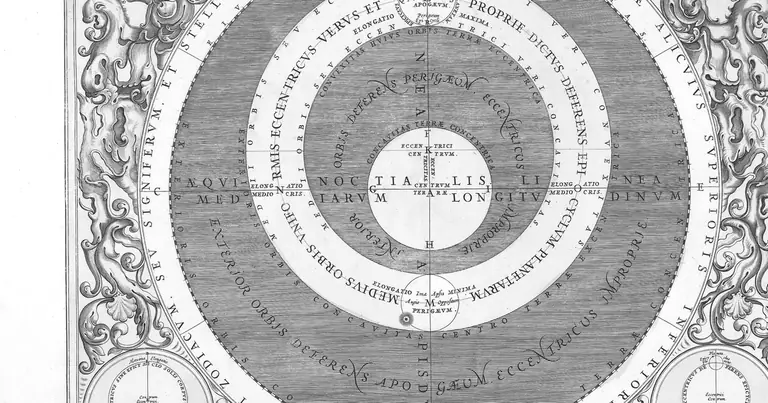
The word comes from the Latin for "going backward," and for a few weeks or months that is how the planet looks from Earth, as if it had slipped into reverse through the zodiac. Nothing in space has actually turned around. It is a trick of perspective, and tradition treats it as a signal to slow down and go back over that planet's territory.
Two cars on a track: the illusion of going backward
Picture two cars on a track at different speeds. As the faster one overtakes the slower, the slower seems to drift backward against the scenery for a while. The same thing happens as Earth laps an outer planet, or as Mercury and Venus swing past us on the inside. The planet never stops orbiting forward; only our line of sight makes it appear to backtrack. Every planet does this except the Sun and Moon. Mercury retrogrades three or four times a year for about three weeks each time, while the outer planets spend months in retrograde annually.
Retrograde as review and revisiting
Tradition reads retrograde motion as a turn inward. The planet's usual business gets reviewed, revisited and reworked rather than launched fresh. Mercury, the planet of messages and travel, is the famous one, tied to crossed wires, delays and second drafts. Astrologers often frame a retrograde as a chance to finish old business, not a curse, and advise patience over big new starts.
The last Mercury retrograde of 2026, in Scorpio
The last Mercury retrograde of 2026 runs from 24 October to 13 November, all of it in Scorpio. Venus is retrograde at the same time, from 3 October to 13 November, so for three weeks two planets show backward motion together. Read in the traditional way, it is a window to back up your files, reread contracts before signing, and reconnect with people from the past, rather than a time to sign a lease or buy a new laptop on a whim.
Not just Mercury: stations and shadow periods
Planets do not physically reverse; the motion is apparent only. Retrograde is also not a Mercury-only event, since every planet but the two lights does it. Each retrograde is bracketed by a slow station at either end, and the pre- and post-shadow periods around it are often folded into the same transit story. Those shadow spans are the stretches before and after the backward run when the planet covers the same degrees it will revisit, and many readers count them as part of the whole cycle.
Live retrograde dates and degrees
The NovaOracles Mercury retrograde tracker shows the live dates and degrees, how to survive Mercury retrograde keeps it practical, and retrograde planets in 2026 covers the slower ones.
FAQ
Frequently asked questions
What does retrograde mean in astrology?
A planet that appears to move backward through the zodiac as seen from Earth. It is an optical effect, and astrologers read it as a time to review and revisit that planet's themes.
When is Mercury retrograde in 2026?
Three times: roughly 26 February to 20 March in Pisces, 29 June to 23 July in Cancer, and 24 October to 13 November in Scorpio. Dates shift by a day across time zones.
Do planets really move backward?
No. The planet keeps orbiting forward. The apparent reversal comes from Earth and the other planet moving at different speeds, changing our line of sight to it.
Sources
Try it
Open the free toolThe Journal
How a transit touches your chartRead the guide
TransitsSee how this shows up in your own chart.
Find it in my chart