Foundations
Your Vedic Astrology Chart, Explained
NovaOracles, by OZGN Studio · September 18, 2026
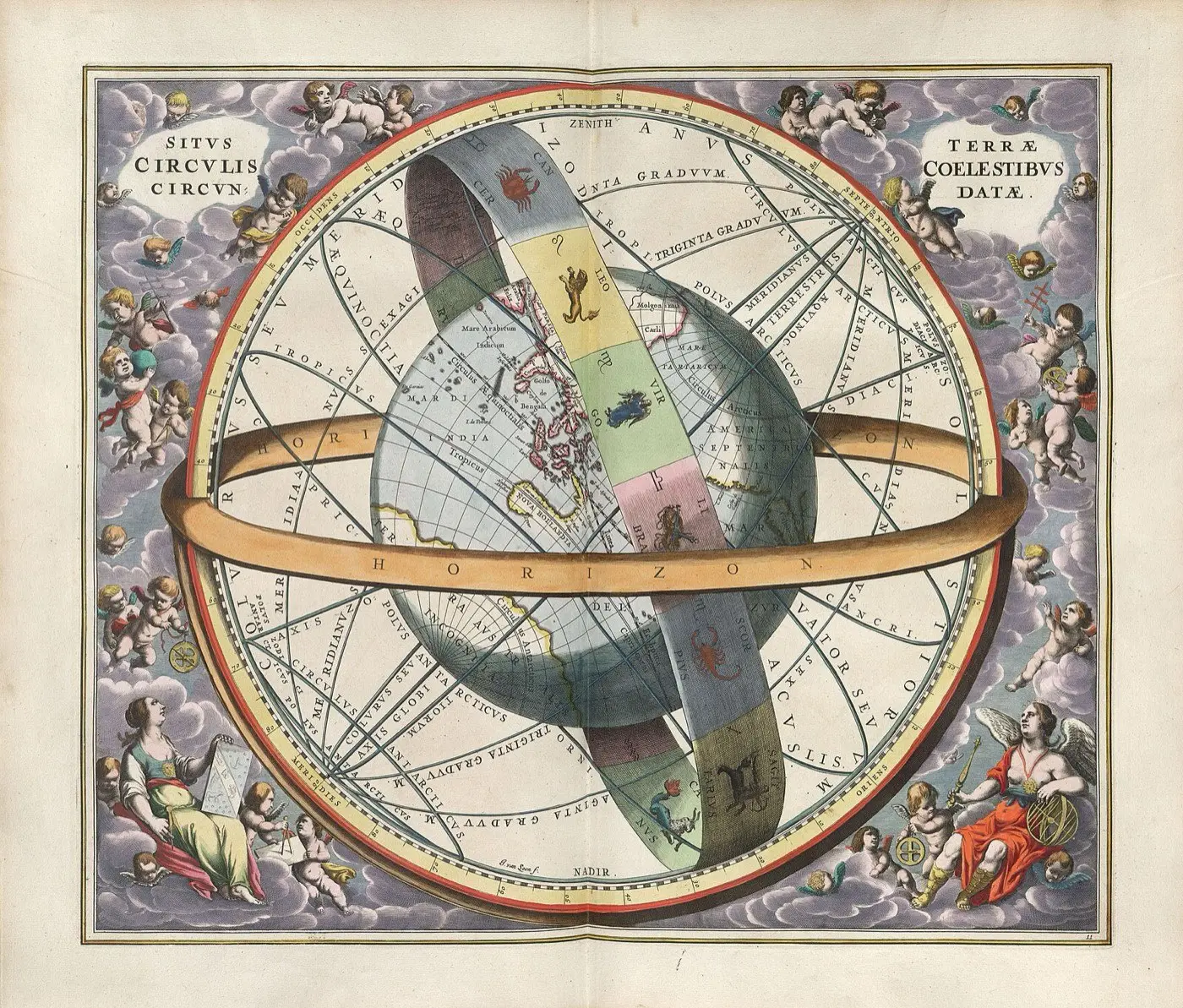
A Vedic astrology chart is the same birth chart you may know from the West, the sky mapped at the moment you were born, drawn in a different zodiac. Western astrology uses the tropical zodiac, tied to the seasons; Vedic astrology, the tradition of the Indian subcontinent also called Jyotish, uses the sidereal zodiac, tied to the fixed stars. That single choice of starting line is the root of nearly every difference between the two, including the common surprise of finding your Sun in a sign you never expected. Everything else, the planets, the houses, the angles, is built on real astronomy the same way, so the place to understand a sidereal chart is that starting line.
The two systems are not arguing about where the planets are. A planet sits at one point on the ecliptic, the Sun's yearly path, and both traditions agree on that point down to the arcminute. What they disagree on is where to put the zero mark from which every sign is counted. Move the zero and every planet keeps its true position in the sky while sliding to a new label. That is the whole mechanism, and it is worth walking through slowly, because it explains the part people find hardest to believe.
What a Vedic astrology chart is
A Vedic astrology chart is cast from three facts, the same three any chart needs: your date, your exact time, and your place of birth. From those it locates the Sun, Moon and planets on the ecliptic and works out the rising sign, then lays the twelve houses over them. In Indian practice the chart is often drawn as a square diagram rather than the round wheel common in the West, and it is read with its own long list of techniques, but underneath the different picture it is the same observed sky. The map is identical; the grid printed over it is shifted.
Where a Vedic chart parts company from a Western one is the grid, the zodiac itself. The Western tropical zodiac fixes zero degrees of Aries to the spring equinox, the point where the Sun crosses the equator each March. The Vedic sidereal zodiac fixes its signs to the band of constellations that gave them their names. Long ago the two lined up almost exactly. They no longer do, and the reason is a slow wobble of the Earth that neither tradition can stop.
Sidereal versus tropical, the real difference
The Earth spins like a top, and like a top it wobbles. Its axis traces a slow circle against the stars, one full turn about every twenty six thousand years. This is called the precession of the equinoxes, and its visible effect is that the equinox point, the tropical zero, creeps backward through the constellations at a steady crawl: a little over fifty seconds of arc a year, which comes to roughly one degree every seventy two years. Over two thousand years that crawl adds up.
The gap it has opened between the two zodiacs is called the ayanamsa, and today it stands at about twenty four degrees. That is the number that matters for a reader. A sidereal chart places every planet roughly twenty four degrees earlier in the zodiac than a tropical chart does, because it is measuring from a starting line the seasons abandoned centuries ago. The planets have not moved relative to the stars; the seasonal zero has slid out from under them. Vedic astrology keeps its signs pinned to the stars, so it reads the sky the way it looked from the starting line the constellations still mark.
Why your Vedic signs come out different
Here is the consequence people feel personally. The Sun moves about one degree a day along the ecliptic, so a shift of about twenty four degrees is worth roughly twenty four days. If your birthday falls in the first three weeks or so of your Western sign, your sidereal Sun very often lands in the sign before it. A late-March Aries can read as a sidereal Pisces; an early-August Leo can read as a sidereal Cancer. Nothing about you changed. The label moved, because the two systems count from different places.
Not every placement jumps. If a planet sat late in a sign under the tropical count, subtracting twenty four degrees may leave it in the same sign, only nearer the start. So a sidereal chart is not simply your Western chart with every sign bumped back one; it is your Western chart with every planet moved twenty four degrees, and each one crosses a sign boundary or not depending on where it already stood. The way to see your own version is to compute your exact chart, note the precise degree of each planet, and carry each one back by the current ayanamsa. The birth chart calculator gives you those exact tropical degrees from real ephemeris data, which is the number you need before any sidereal conversion means anything.
The Moon takes the lead
Vedic astrology is not only Western astrology with the signs shifted. It also reads the chart with a different center of gravity. Western practice leads with the Sun, the sign of your birthday. Vedic practice leads with the Moon and with the rising sign, the ascendant, which it calls the lagna. Ask a Vedic astrologer your sign and they are more likely to answer with your Moon sign, your rashi, than with your Sun. The chart is often read house by house from the rising sign, and the Moon is treated as the near-daily weather of the mind.
This change of emphasis matters as much as the change of math. A person who feels their Western Sun sign never fit them sometimes finds the Vedic Moon sign lands closer, not because one system is truer but because it is pointing at a different part of the same chart. If you have never looked at your own rising sign, the rising sign calculator and the rising sign guide are a good doorway into the placement Vedic astrology treats as the frame of the whole reading.
The nakshatras, the lunar mansions
Vedic astrology adds a layer the West mostly dropped: the nakshatras, or lunar mansions. Alongside the twelve signs, the sidereal ecliptic is divided into twenty seven equal segments, each a little over thirteen degrees, and the Moon spends about a day in each as it circles the sky. Your birth nakshatra, the mansion the Moon occupied when you were born, is a central piece of a Vedic reading, used for character, for timing, and in the tradition even for matching couples.
The nakshatras feed one of the system's signatures, the dasha cycles, long planetary periods that divide a life into chapters each ruled by a different planet. It is a way of reading time that the tropical West does not really have an equivalent for. You do not need to master any of it to get the main point of a sidereal chart, but it is worth knowing that Vedic astrology is a full and separate craft, not just a twenty four degree adjustment to a familiar one.
How to read your own sidereal chart
Start from the real astronomy, because both zodiacs share it. Compute your exact chart and read off each planet's degree along the ecliptic. Then carry each planet back by about twenty four degrees, the current ayanamsa, and see which sign it now falls in. Whatever crosses a boundary is where your Western and Vedic charts will disagree, and whatever stays put is where they will quietly agree. That simple exercise demystifies most of the surprise.
Keep the two readings in separate hands rather than trying to make them agree. The tropical chart is a map of the seasons and the Sun's yearly rhythm; the sidereal chart is a map of the fixed stars and leans on the Moon and the lagna. Neither cancels the other, and plenty of people read both. If you want the groundwork under the Western side first, the zodiac guide sets out how the tropical wheel is built, and The zodiac, explained covers the twelve signs in more depth. With that in place, the sidereal chart stops looking like a contradiction and starts looking like a second, older way of reading the very same sky.
FAQ
Frequently asked questions
- What is a Vedic astrology chart?
- It is a birth chart drawn in the sidereal zodiac, the system used in Indian astrology, called Jyotish. The planets are placed against the fixed stars rather than against the seasons, which is the one technical difference that changes almost everything downstream, including which sign many of your placements land in.
- Why is my Vedic sign different from my Western sign?
- Because the two systems measure from different starting points, and those points have drifted apart by about twenty four degrees. A sidereal chart places each planet roughly twenty four degrees earlier, so if your birthday falls in the first three weeks or so of your Western sign, your Vedic Sun usually lands in the sign before it.
- What is the sidereal zodiac?
- It is a zodiac anchored to the actual constellations. The tropical zodiac used in the West is anchored to the spring equinox instead, and because the equinox slowly slips backward against the stars, the two have separated over the centuries. Vedic astrology keeps to the stars; Western astrology keeps to the seasons.
- Does Vedic astrology use the same planets?
- The classical Vedic chart uses the seven visible bodies plus the two lunar nodes, and traditionally leaves out the modern planets discovered by telescope. It also leans far more on the Moon and the rising sign than on the Sun, which is a change of emphasis as much as a change of math.
Sources
Terms in this piece
Read your own sky, not a generic one.
NovaOracles computes your full natal chart from real astronomy: your rising sign, your big three, every house and every aspect, personal to the minute you were born.
Get your full chart