The sky
First Quarter Moon: What It Is, How to Spot It and What It Means
NovaOracles ·
The first quarter moon is the half moon of the evening sky, about a week after the new moon, and from the US its right half is the bright one.
NovaOracles ·
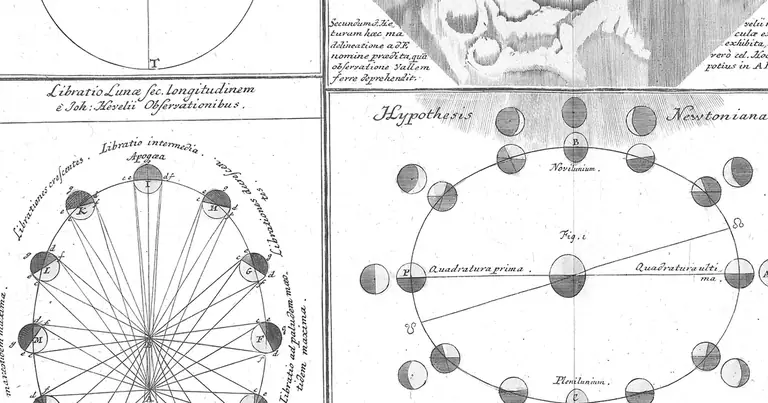
The first quarter moon is the half moon of the evening sky, about a week after the new moon, and from the US its right half is the bright one. The next one falls on November 17, 2026, at 6:48 a.m. EST, when the Moon has covered a quarter of its monthly orbit. For moonrise and moonset in your own city, open the lunar calendar.
§ 01What is the first quarter moon?
Seen from Earth, the Moon at first quarter sits 90 degrees east of the Sun. Sunlight hits it side-on, so exactly half of the face turned toward us is lit. Astronomers give the first quarter a time to the minute, as they do for a new or full moon, which makes it strictly an instant. Most people use the name for the evening nearest that instant, when the Moon looks cut cleanly in half.
The name confuses a lot of people, because a "quarter" moon is half lit. The word counts progress through the cycle. One new moon follows another every 29.5 days or so, and the first quarter falls a quarter of the way through, 7.4 days after the new moon on average. Between the new moon and the full moon there are three stages: the thin waxing crescent, the half-lit first quarter and the waxing gibbous. Our phases of the Moon guide shows how all eight phases fit together.
The first quarter is one of the four principal phases, along with the new moon, the full moon and the last quarter. These are the four moments printed on most wall calendars, and they are the only ones with an exact time attached. The phases in between, such as the crescents and the gibbous phases, are stretches of several days.
§ 02How do you recognize a first quarter moon in the sky?
The shape, the lit side and the clock each give it away. The line between light and shadow, called the terminator, runs straight down the middle of the disk. A day before the quarter that line still curves the other way, leaving a fat crescent, and a day after it bows outward into a gibbous shape. North of the equator, in the US, Canada or Europe, the right half shines. From Australia, South Africa or Argentina it is the left half, because south of the equator the Moon appears rotated half a turn.
The timing is just as reliable. A first quarter moon rises around midday, stands highest in the south around sunset and sets around midnight. That makes it the easiest phase to catch in daylight: on a clear afternoon you can find it pale against the blue, well above the eastern horizon. By dusk it is the brightest thing in the southern sky. In late winter and spring, when the first quarter Moon rides high, it can stay up until 2 or 3 a.m., but it is always gone well before dawn.
A half moon gives far less light than you might expect, only about a tenth of what a full moon gives. Sunlight reaches it at a low angle, and every crater wall and mountain range throws a long shadow across the surface. Those shadows make the first quarter the favorite phase of people with binoculars or a small telescope. Near the terminator, craters and ridges stand out in sharp relief. For a few hours shortly before the first quarter, sunrise catches the rims of three craters, Blanchinus, La Caille and Purbach, while their floors are still dark. Against the shadow at the terminator the lit rims form a small bright X, which amateur astronomers call the Lunar X.
§ 03When is the next first quarter moon?
Here is every first quarter from November 2026 through December 2027, by our calculation, in New York time and with the sign the Moon is in at that moment:
| Date | New York time | Moon in |
|---|---|---|
| November 17, 2026 | 6:48 a.m. EST | Aquarius |
| December 17, 2026 | 12:43 a.m. EST | Pisces |
| January 15, 2027 | 3:35 p.m. EST | Aries |
| February 14, 2027 | 2:58 a.m. EST | Taurus |
| March 15, 2027 | 12:25 p.m. EDT | Gemini |
| April 13, 2027 | 6:56 p.m. EDT | Cancer |
| May 13, 2027 | 12:44 a.m. EDT | Leo |
| June 11, 2027 | 6:56 a.m. EDT | Virgo |
| July 10, 2027 | 2:39 p.m. EDT | Libra |
| August 9, 2027 | 12:54 a.m. EDT | Scorpio |
| September 7, 2027 | 2:31 p.m. EDT | Sagittarius |
| October 7, 2027 | 7:47 a.m. EDT | Capricorn |
| November 6, 2027 | 4:00 a.m. EDT | Aquarius |
| December 6, 2027 | 12:22 a.m. EST | Pisces |
Times are computed by our ephemeris engine; how we calculate. Chicago runs one hour behind New York and Los Angeles three, which can move an early-morning quarter back to the previous date.
Many of these instants fall when the Moon is below the horizon in the US, and that matters less than it seems. The Moon changes slowly enough that it looks half lit to the eye on the evening closest to the time shown. The November 17 quarter comes at 6:48 a.m., after moonset, so the evenings of November 16 and 17 both show a near-perfect half. The lunar calendar gives the exact rise and set times for your location.
The sign column follows a simple pattern. The first quarter Moon is 90 degrees ahead of the Sun, so it usually sits three signs after the sign of the new moon that opened the cycle. The new moon of November 9, 2026 is in Scorpio, and the first quarter eight days later is in Aquarius. All the new moons of the coming years are listed on our new moon page.
§ 04How does the first quarter differ from the phases next to it?
Before it comes the waxing crescent moon, a thin evening Moon with less than half of its disk lit. It sits low in the west after sunset and grows a little wider each night. After the first quarter comes the waxing gibbous moon, with more than half lit. It rises in the afternoon and rides high for most of the night until the Moon turns full roughly seven nights on. The first quarter is the turning point between the two, the night the crescent fills out to half and starts to swell past it.
Its mirror image is the last quarter moon, which comes about two weeks later. That one is also half lit, but on the left from the Northern Hemisphere, and it keeps the opposite hours. It rises around midnight and is still high in the south at sunrise. The quickest test works anywhere in the world: a half moon in the evening sky is a first quarter, and a half moon in the morning sky is a last quarter.
§ 05What does the first quarter moon mean in astrology?
In astrology the first quarter is a square, the 90-degree angle between the Sun and the Moon, and tradition links that angle with friction and the need to act. Dane Rudhyar, the 20th-century astrologer who divided the lunation cycle into eight phases, called the first quarter phase a "crisis in action." The idea is that whatever began at the new moon has now run into the real world. Plans meet obstacles, early enthusiasm meets the calendar, and something has to be decided for the project to keep moving.
People who follow the lunar cycle often use the first quarter as a checkpoint. A week after setting an intention at the new moon, they look at what has moved and what has stalled, and they pick the next concrete step. The full moon a week later is read as the moment results become visible. The first quarter, by that logic, is the time to commit, adjust the plan or drop the part that is clearly not working.
The sign adds a second layer. A first quarter in Aquarius, like the one on November 17, is read through themes of friendship, groups and independence. The one in Taurus on February 14, 2027 is read through steady effort, comfort and practical resources. To find the Moon's sign for a date of your own, try the moon sign tool.
Read all of this as a tradition for reflection, a monthly prompt that some people like to use. The square between the Sun and the Moon makes no decision for you, and the astronomy earlier on this page holds true whether you follow the symbolism or not.
FAQ
Frequently asked questions
Why is it called a first quarter moon when half of it is lit?
The name counts progress through the cycle. At first quarter the Moon has gone a quarter of the way around its orbit since the new moon, about 7.4 days into a cycle of roughly 29.5 days. What we see at that point happens to be half of the disk lit, which is why many calendars also call it a half moon.
Can you see the first quarter moon during the day?
Yes. A first quarter moon rises around midday, so on a clear afternoon it hangs in the eastern or southeastern sky as a pale half disk while the Sun is still up. It is easiest to spot an hour or two before sunset, and it stays visible until it sets, usually around midnight.
Is the first quarter moon waxing or waning?
Waxing. The first quarter comes between the new moon and the full moon, so the lit part is still growing. The half moon you see a week after the full moon is the last quarter, which is waning and lit on the opposite side, on the left from the Northern Hemisphere.
Terms in this piece
Have your own sky read to you every morning
Membership gives you a short reading each morning based on today's sky and your birth chart, plus your transits, your relationships and your year.
Membership includes
- Your daily reading based on your birth chart
- Your daily scores across 7 areas of life
- The hours your chart highlights each day
- Your precisely calculated birth chart
Membership from €3.99 a week. Cancel anytime.