The sky
Waning Gibbous Moon: What It Is, When You See It and What It Means
NovaOracles ·
The waning gibbous moon is the phase right after the full moon: the disk is still more than half lit, but it loses light every night.
NovaOracles ·
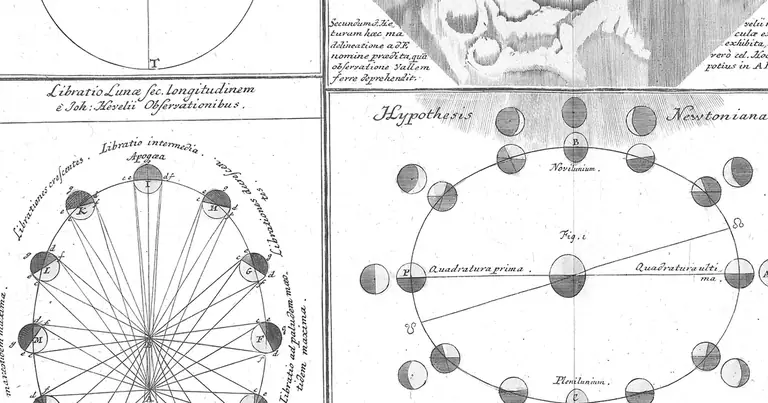
The waning gibbous moon is the phase right after the full moon: the disk is still more than half lit, but it loses light every night. It lasts about a week, from the full moon to the last quarter, and seen from the US the bright side faces left. The next one runs from November 24 to December 1, 2026. It rises later every evening, and the lunar calendar tells you when it comes up over your town.
§ 01What is a waning gibbous moon?
"Waning" means shrinking. "Gibbous" goes back to the Latin gibbus, a hump, which suits the swollen outline of a Moon past half. Put together, the name describes a Moon more than half lit that loses a little more light each night. The phase begins at the full moon, when the whole face is lit, and ends at the last quarter, when exactly half of it is.
The Moon is moving back toward the Sun in the sky. At the full moon it stood opposite the Sun, and every day after that it slips about 12 degrees closer, so we see a little less of its sunlit half. From the Northern Hemisphere the shadow eats in from the right, the side that was lit first during the waxing half of the month. The first night or two the Moon still looks round to the naked eye. By the fourth or fifth night the flattened right edge is obvious, and by the end of the week the Moon has shrunk to a half.
In the eight-phase cycle the waning gibbous is the sixth phase, between the full moon and the last quarter. All eight are laid out in order in our phases of the Moon guide.
§ 02When and where can you see the waning gibbous moon?
The waning gibbous is a late-evening and morning Moon. It rises in the east after sunset, about 50 minutes later each night on average. The night after the full moon it clears the horizon roughly 40 minutes to an hour after sunset. By the end of the phase it does not rise until around midnight. Once up, it stays in the sky for the rest of the night, stands highest in the south in the small hours and is still visible in the western sky after sunrise.
That morning view is how most people meet this phase. A large, slightly lopsided Moon low in the west after sunrise is almost always a waning gibbous.
The late rise also opens a moonless gap after dusk. Right after the full moon that gap is short and still lit by twilight, but it widens by about 50 minutes a night, and by the last quarter the whole evening until around midnight is dark. Stargazers who want a dark evening without waiting for the new moon often use the second half of this week.
§ 03When are the next waning gibbous moons?
Every waning gibbous starts at a full moon and ends at a last quarter, so those two instants mark its window. By our calculation, the remaining windows of 2026 and all of 2027 run as follows, in New York time:
| Full moon (start) | Last quarter (end) |
|---|---|
| November 24, 2026, 9:54 a.m. EST | December 1, 2026, 1:09 a.m. EST |
| December 23, 2026, 8:28 p.m. EST | December 30, 2026, 2:00 p.m. EST |
| January 22, 2027, 7:17 a.m. EST | January 29, 2027, 5:55 a.m. EST |
| February 20, 2027, 6:24 p.m. EST | February 28, 2027, 12:16 a.m. EST |
| March 22, 2027, 6:44 a.m. EDT | March 29, 2027, 8:54 p.m. EDT |
| April 20, 2027, 6:27 p.m. EDT | April 28, 2027, 4:18 p.m. EDT |
| May 20, 2027, 6:59 a.m. EDT | May 28, 2027, 9:58 a.m. EDT |
| June 18, 2027, 8:44 p.m. EDT | June 27, 2027, 12:54 a.m. EDT |
| July 18, 2027, 11:45 a.m. EDT | July 26, 2027, 12:55 p.m. EDT |
| August 17, 2027, 3:29 a.m. EDT | August 24, 2027, 10:27 p.m. EDT |
| September 15, 2027, 7:04 p.m. EDT | September 23, 2027, 6:20 a.m. EDT |
| October 15, 2027, 9:47 a.m. EDT | October 22, 2027, 1:29 p.m. EDT |
| November 13, 2027, 10:26 p.m. EST | November 20, 2027, 7:48 p.m. EST |
| December 13, 2027, 11:09 a.m. EST | December 20, 2027, 4:11 a.m. EST |
Times are computed by our ephemeris engine; how we calculate. On Central time take one hour off each entry, on Pacific time three.
The windows are not all the same length. The shortest here, from November 24 to December 1, 2026, lasts 6 days and 15 hours, and the longest, from June 18 to June 27, 2027, runs just over 8 days. The first window opens with the full moon of November 24, 2026, which has its own page: full moon November 2026.
Three of the 2027 windows open with a penumbral lunar eclipse, on February 20, July 18 and August 17, since a lunar eclipse can only happen at a full moon. None of them darkens the Moon much, and the July one takes place while the Moon is below the horizon in New York and Los Angeles. Our lunar eclipse guide gives the times and where each one can be seen.
§ 04How does the waning gibbous differ from the phases next to it?
The full moon comes right before it, and on the first night after the full moon the two are hard to tell apart by eye. The clock settles it. A full moon rises at about sunset, opposite the Sun, while a waning gibbous rises a little later each evening. If the Moon looks round but comes up an hour or more after dark, the full moon has passed.
At the other end, the last quarter moon closes the phase. There the terminator, the line between light and shadow, cuts the disk into two equal halves, while a gibbous Moon still bulges past that line. After the last quarter the Moon thins into the waning crescent moon, the sliver of the last week before the new moon.
The phase people confuse it with most is its twin on the other side of the full moon, the waxing gibbous moon. North of the equator the dark bite sits on the right of a waning gibbous and on the left of a waxing one, and south of the equator it is reversed. If you are unsure which side is which, go by the hour. A big Moon you can see over breakfast, or one that only clears the rooftops well after dark, is waning. One already up in the afternoon sky is waxing.
§ 05What does the waning gibbous moon mean in astrology?
In Dane Rudhyar's eight-phase scheme of the lunation cycle, this week is the disseminating phase. To disseminate originally meant to scatter seed, and the tradition reads the week after the full moon as a time to pass on what the full moon brought to light. The new moon started something, the first quarter pushed it into the world, and the full moon showed the result. The waning gibbous turns outward with what was learned.
In practice that suggests a sharing week. People who follow the cycle use these days to explain, teach, write things up, give feedback and say thank you. It is also a natural time to share the load: hand over tasks, ask for help and let others build on what you started. The pace is often described as calmer than the push before the full moon, with energy going into conversations more than into new starts.
The sign gives the week its color. A waning gibbous moves through roughly three signs after the sign of the full moon, so the one after the November 24, 2026 full moon in Gemini passes through Cancer and Leo before the last quarter in Virgo. For the sign on a particular night, check the moon sign tool.
This reading belongs to astrological tradition and works best as a prompt for reflection. The rise times and dates on this page are astronomy, true with or without it.
FAQ
Frequently asked questions
How long does a waning gibbous moon last?
About a week. The waning gibbous runs from the full moon to the last quarter, 7.4 days on average. The Moon speeds up near perigee and slows near apogee, so the real stretch varies from about 6.5 to just over 8 days. The window from November 24 to December 1, 2026 lasts 6 days and 15 hours.
What time does the waning gibbous moon rise?
It rises after sunset, later each night. A day after the full moon it comes up about an hour after the Sun goes down, and by the last quarter it rises around midnight. It then stays up through the rest of the night and is still in the western sky after sunrise.
What is the difference between a waning gibbous and a waxing gibbous?
Both are more than half lit, and the full moon falls between them. The waxing gibbous comes first and fills out a little more each night. From the Northern Hemisphere its bright side is on the right, and it is already up by late afternoon. The waning gibbous follows the full moon, loses light each night, shows its bright side on the left and rises after dark, so it is the one still visible in the morning.
Terms in this piece
Have your own sky read to you every morning
Membership gives you a short reading each morning based on today's sky and your birth chart, plus your transits, your relationships and your year.
Membership includes
- Your daily reading based on your birth chart
- Your daily scores across 7 areas of life
- The hours your chart highlights each day
- Your precisely calculated birth chart
Membership from €3.99 a week. Cancel anytime.